Cassava is a starchy root, similar to potatoes in many ways but also very different in others. Also known as Yuca or Manioc, the plant is original of Latin America. Personally, the first time I tried Cassava I was already well over into my 20s. I have grown to like it quite a lot though, and even tried cooking with it myself!
Cassava’s basics
Cassava roots have an elongated round shape which can reach even more than 30cm (12 inches) in length and sometimes up to 5-6cm (2-2.5 inches) in diameter. Cassava is also quite hard to the touch and kind of difficult to peel. If this wasn’t enough, raw cassava is toxic in all its parts (its starchy content, the peel and even the leaves), as it naturally contains cyanide. This post of the FAO (Food and Agriculture Organization) explains it rather well.

At this point we could even say that it’s really trying to not be eaten, but fear not! If cooked properly Cassava root is very safe to eat, and luckily it’s easy to remove its toxicity and turn it into a delicious meal.
Cutting and Peeling Cassava
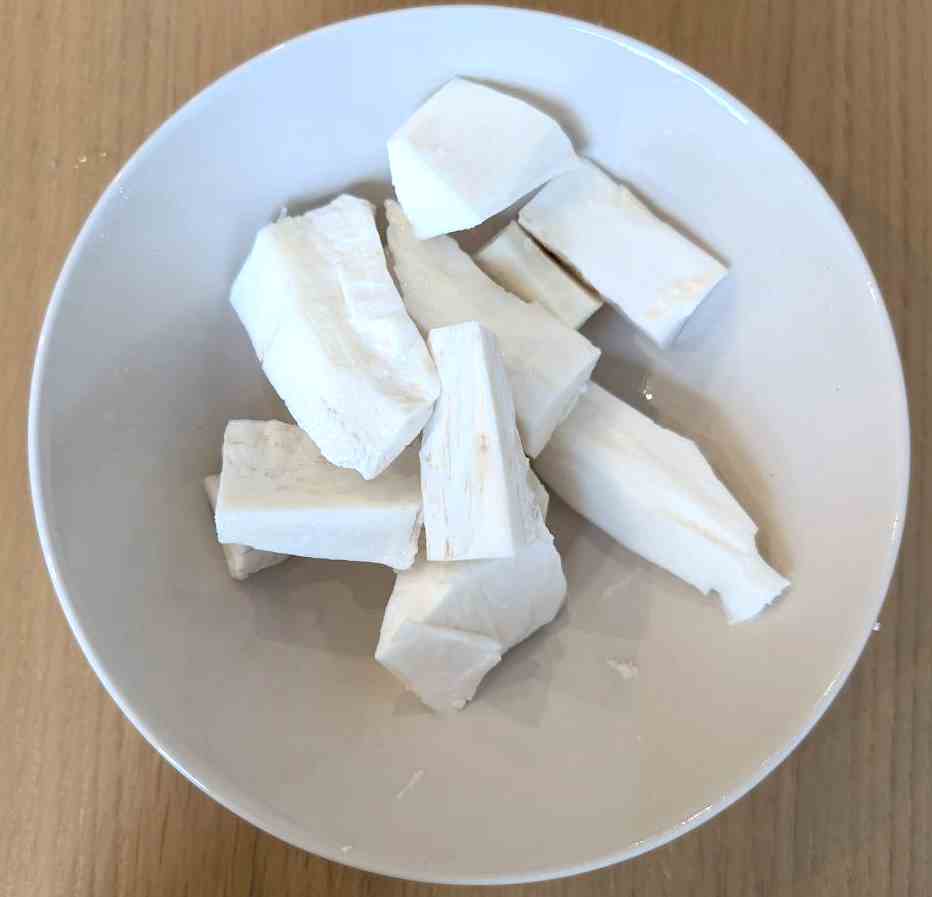
Like we said before, due to its hard nature Cassava roots can prove to be quite a challenge to peel and chop. You pretty much stand no chance with a small knife, and the more flexible knives might even struggle piercing through the root. Similarly, a cheap peeler might work well for carrots and potatoes but it might break on Cassava’s hard peel.
If you have a strong enough peeler, you can try with that, otherwise go with a sharp knife directly. Once peeled, you’ll find that inside of the Cassava is white in color and, surprise surprise, just as hard as the outside!
If you proceed to chop the Cassava, you’ll also notice that the inner core often contains several strong fibers. Removing them is a crucial step for the success of most dishes you’ll make with Cassava, as they don’t cook well and are annoying to eat. In order to remove them, simply pull them out with the help of a knife.
Removing the toxicity
As we said before, one crucial step in using this ingredient is to remove its toxicity. There are several ways to do this, but we can focus on the ones we can easily achieve in the kitchen. Quoting this Food and Agriculture Organization’s article for the quantities:
- Peeling it can reduce its cyanide level by more than 50% alone, as the peel naturally contains more of it;
- Boiling/Cooking can reduce the content of free cyanide by up to 90% within 15 minutes and bound cyanide by up to 55% within 25 minutes;
Other alternatives, which can be much more time-consuming, include soaking (even for days), fermenting and drying. Do not let the numbers scare you though, plenty of foods contain varying amounts of naturally occurring cyanide! Cssava happens to contain slightly more than others, but following recipes properly makes it very safe to eat!
Cooking the Cassava!
So, have you made up your mind and decided to try making something out of this? I got you covered! Check out my recipe to make some delicious Cassava Fries, an alternative snack that everyone at the table will enjoy. Pair this up with a sauce of your choice and you won’t regret it!

Cassava Fries
Cassava Cassava is a starchy root vegetable, rich in carbohydrates, with a good content of proteins and fibers and low on fats. Also known as Yuca or Manioc, this plant originates from Latin America. I tried Cassava Fries for the first time at a friend’s place a few years ago and I loved them! They are are great alternative to…

Leave a Reply